
The Hurdman Silver-Zinc Project is located 120 km north of Timmins, Ontario, and consists of 13 contiguous mining claims, comprising 184 individual claim units and covering 2474 hectares in Hurdman Township (NTS 42 H/12). These cover known mineralization, as well as structural and geophysical targets that are considered prospective for additional silver and zinc mineralization.
The Hurdman Zinc-Silver Property has these features:
- The Hurdman Sulphide Zone is a buried deposit characterized by an east-west strike over approximately 450 m and dipping 15-25o north over at least 350 m. The zone has a similar strike and dip to the surrounding rocks.
- The mineralized host rock is biotite-sillimanite-quartz-feldspar gneiss. The well mineralized portions of the host rocks are described as being silicified and rich in sillimanite, containing a number of alteration minerals including gahnite, anthophyllite, cordierite and tremolite.
- Sulphide minerals are predominantly in disseminated form but can increase to 25-30% semi- massive sulphides and 60-90% massive sulphides over 0.5 to 2 metres core lengths. The more massive zones are referred to as ‘lodes’, but cannot be easily interpreted between drill holes at current drill spacing.
- Some of the better intersections range from 2-5% Zn and 10-40 g/t Ag over 10-30 m thickness; gold grades ranging from 2 – 6 g/t Au over 0.5 – 1 m are linked to very coarse pegmatite veins and dykes, located at the footwall of the semi-massive sphalerite horizons.
- In the 2008 DDH program, a VTEM anomaly 1.5 km east of the HSZ was found to contain similar mineralization and was referred to as East HSZ. The zone occurs at the eastern strike extension of the HSZ.
- The HSZ is considered to be an Archean Sedex-type deposit, but with low Pb and Cu values, that has undergone high-grade upper amphibolite to granulite facies metamorphism and accompanying deformation; reference to a Geco-type deposit such as the Geco 8/2 Zn Zone have been made.
The Hurdman Silver-Zinc mineralization occurs 450 metres along strike as Silver-Zinc rich semi-massive to massive sulphides, dipping 15 to 25 metres north, within 150 metres of surface. Historical drill widths vary from 1 to 38 metres in true thickness, and the mineralization remains open in all directions. One significant drill intercept is 3.0% zinc and 12.1 g/t silver over 23.6 metres. There are also significant gold intercepts including 48.7 g/t Au over 0.5 metres and 2.5 g/t Au over 4.1 metres. There are numerous untested conductors and structural corridors that may host additional mineralization. Hurdman occurs at the juncture of the Quetico Metasedimentary Belt and the Kapuskasing Structural Zone and is considered to be an Archean Sedex type deposit.
April 14. 2026 update: Argo Gold Inc. recently acquired through staking an additional 35 square kilometres at the Hurdman Silver-Zinc Project, located 120 km north of Timmins, Ontario, and now holds 60 square kilometres covering the known silver-zinc mineralization, as well as structural and geophysical targets that are considered prospective for additional silver and zinc mineralization.
Project Location


Claim Description
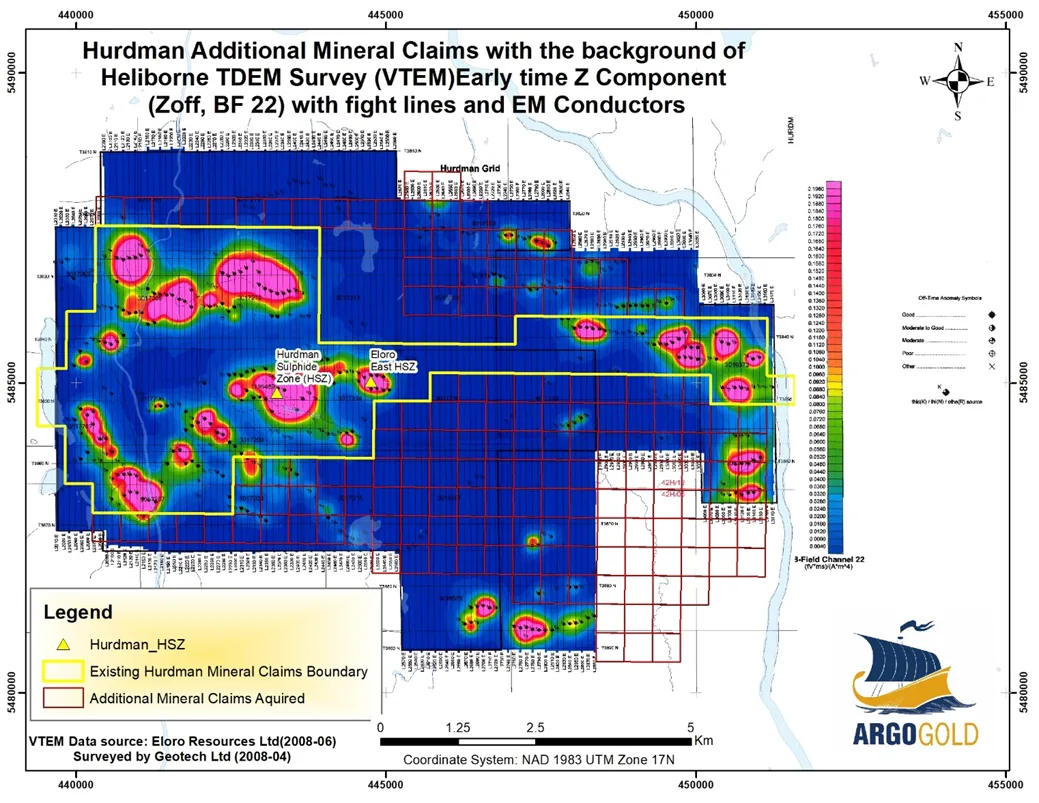
- Core claims of 2,474 Ha (shown in map above, in green), recently staked strategic claims covering an additional 5,601 Ha (shown in map above, in pink), totalling 8,075 Ha
- The Hurdman Sulphide Zone mineralization: considered to be Archean Sedex-type deposit
- The stratabound Zn-Ag deposit occurs at the juncture of the Quetico Metasedimentary Belt and the Kapuskasing Structural Zone
- Significant number of additional surrounding drill targets

National Instrument 43-101 Disclosure
The technical information in this news release has been reviewed and approved by Michael Guo, who is a “Qualified Person” as defined in National Instrument 43-101. Historical geochemical, drilling results and geological descriptions quoted in this news release are from historical data, previous news releases, a technical report on Hurdman dated March 2018, and from information provided by the Government of Ontario. Management cautions that historical results or discoveries on adjacent or nearby mineral properties are not necessarily indicative of the results that may be achieved on Argo’s mineral properties.
Project Geology
Fifty three diamond-drill holes, comprising 7444 m, were completed; a total of 1955 altered/mineralized samples were collected from 51 drill cores and submitted for assay. In addition, 120 samples were collected (2005 and 2008 cores) and submitted for whole rock analysis, and 189 pulps from the 2006 and 2007 drilling were re-assayed for lead in 2008. As a result of Eloro’s work, it has been confirmed that:
- The zinc-silver mineralization of the Main Hurdman Sulfide Zone (HSZ) is spatially associated with and mostly peripheral to pyrrhotite-pyrite lodes and pegmatite sills, which are within an alteration envelope of pale grey, sillimanite-bearing rocks that contain disseminated and “blebby” sphalerite;
- The east-west extent of the Main HSZ is at least 350 m and its north-south extent is at least 300 m; the top of the altered/mineralized envelop is close to surface (beneath glacial deposits) in the most southern holes but it is below 100 m vertical depth in the most northern holes, indicating a shallow dip to the north;
- The thickness of the altered/mineralized envelope is variable; drill intersections range from 2 to 50 m but generally exceed 5 m;
- Zinc and silver grades in the Main HSZ range from 1.45% to 13.8% Zn and from 2.55 g/t to 166 g/t Ag over widths ranging from 0.5 to 28.2 m; elevated gold values (> 1 g/t Au) are erratic but range from 1.15 to 48.69 m over drill widths ranging from 0.4 to 7.9 m;
- Within the altered/mineralized envelope, there is a corridor that varies between 1.9 m and 19.95 m in apparent thickness, which contains zinc values > 2 % and silver values > 15 g/t.
- A new zone, the East HSZ, occurs approximately 1.5 km east of the main zone and it dips gently to the northeast; its extent is unknown but drill intersections of the altered/mineralized envelope are not as thick (< 10 m) as those in the Main HSZ; McCutcheon Geo-Consulting Hurdman 2011
- Zinc and silver grades in the east zone range from 0.5% to 4.94% Zn and from 6 g/t to 266 g/t Ag over widths ranging from 0.4 to 9.8 m; gold values are all < 1 g/t Au;
- The Main and East zones are encompassed by a “geophysical domain” that consists of clusters of point and linear VTEM anomalies;
- There are 5 geophysical domains (D-01 to D-05) and 6 separate VTEM linears (L-01 to L-06) on the Property; the 3 km by 1 km D-04 domain is associated with the HSZ;
- These domains form a horseshoe-shaped pattern that may reflect a large-scale fold in the central part of the Property; the HSZ is at the southeastern end of this horseshoe; and
- Northerly trending magnetic anomalies (at least seven) reflect late-stage dike rocks that cut across this horseshoe. The author believes that the altered mineralized zone at Hurdman represents a melting (anatectic) front in high-grade metamorphic rocks, rather than a primary alteration zone associated with a Sedex or VMS-type massive sulphide deposit.
In this scenario, sillimanite bearing rocks of the HSZ are genetically related to fluids that formed by the breakdown of hydrous minerals (micas and amphiboles) during anatexis; these fluids rose and altered the rocks ahead of the melting front. By reducing the melting temperature, these fluids allowed pyrrhotite-pyrite-sphalerite melts to form, which co-mingled with pegmatite melts at their mutual contacts, forming “ball texture” (analogous to oil droplets in a vinaigrette salad dressing). The partitioning of sphalerite into altered host rocks, rather than the pyrrhotitepyrite lodes, reflects gravity-driven differentiation, i.e. sphalerite has a lower specific gravity than either pyrrhotite or pyrite and thus “floats” in such a melt. An anatectic model explains the shallow dips at both the Main and East HSZ. It also explains why the metal association of the HSZ is atypical for a massive sulfide deposit, i.e. the virtual absence of copper and/or lead. The source(s) of the metals that make up the sulfides of the HSZ is (are) less certain. The metals had to be in the rocks before melting occurred. Whether they were regionally distributed in the sedimentary rocks of the Quetico Terrane or concentrated in a nearby massive sulphide deposit, of either Sedex or VMS type, is uncertain. In the former case, original stratigraphy is not very important because sulfides will be present at the melting front anywhere in the paragneiss (sedimentary) pile. In the latter case, original stratigraphy is critical because sulfides will be present only where the melting front intersected preexisting massive sulphide deposits.


- Eloro identified the Zinc-Silver rich, semi-massive to massive Hurdman Sulphide Zone for 450 metres along strike, dipping 15 to 25 degrees north and within 150 metres of surface
- Drill widths varying from 1 to 38 metres and the mineralization remains open in all directions
- Significant drill results include 3% zinc and 12 g/t silver over a true width of 23.6 metres
- The shallow dip of the deposit is amenable to open pit
- Significant gold credits impact value per tonne
Project History
Eloro Resources Ltd. (“Eloro”) acquired a 100% interest in the Hurdman Property, under an agreement with Don Mc Holdings Ltd and 2060014 Ontario Inc. on November 30, 2004. On August 22, 2011 Eloro entered into a Property Acquisition Agreement (the “Agreement”), with Blue Vista Technologies Inc. (“Blue Vista”), a duly incorporated, Ontario-based corporation.
Pursuant to the terms of the Agreement, Eloro agreed to assign, transfer and sell to Blue Vista all of its rights, titles and interests in the Property, in consideration for which Blue Vista agreed to pay Eloro CAD $40,000, and issue 1,250,000 Common Shares in its capital, upon approval by the regulatory authorities. The Property has been sporadically explored for base-metals from the 1960s to date. In general, past exploration efforts focused on a group of ground EM anomalies, labeled “C”, “G-H” and “I”, which drilling showed to be coincident with areas that contain significant zinc and silver mineralization, according to historical work. Upon acquiring the Property, Eloro commissioned a 43-101 Technical Report that was completed in early 2005 (available on SEDAR), in which a two-phase exploration program was recommended. Since then, four winter diamond-drilling campaigns, and two separate high-resolution airborne Mag /EM surveys have been completed, which essentially met the objectives of the recommended program.
BlueVista becomes Arbitrage Exploration (in 2015), which becomes Argo Gold Inc, (in 2016).
Argo let the claim lapse in 2024, when it was focussed on drilling and developing its oil revenue properties, as not material to the company.
February 19, 2026 Argo Gold Inc. entered into an agreement on February 18, 2026 to acquire a 100% interest in certain mineral claims known as the “Hurdman Silver-Zinc Project”. The Hurdman Silver-Zinc Project is located 120 km north of Timmins, Ontario, totals 2474 hectares covering known mineralization, as well as structural and geophysical targets that are considered prospective for additional silver and zinc mineralization. The mineral claims are being purchased in exchange for the issuance to the vendors of 1,250,000 common shares (subject to a statutory 4-month hold period) and a small net smelter returns royalty (“NSR”) in respect of the mineral claims comprising the Hurdman Silver-Zinc Project.

